
CORE: Coalition of Racial Equity in Mental Health
A journey from Community Health Network Area to Racial Equity non-profit
In 1992, CHNA17 (CORE’s predecessor organization) was established by the MA Department of Public Health as one of 27 quasi-governmental coalitions formed as part of a statewide framework to support community health. These Community Health Network Areas—known as “CHNAs”—were funded by the Commonwealth based on assessments to large health care institutions in each CHNA catchment area.
Today, CORE is a non-profit coalition bringing racial equity to mental health supports for people of color through innovative community collaborations.
Our focus is the intersection of mental health and racial equity for marginalized populations, with an emphasis on African-American/Black residents. CORE believes that changes to improve the health of marginalized people improve health for all people. CORE’s key activities aim to:
- engage our communities
- build leadership to address mental health and racial inequities
- inspire systems change.
We support institutions’ and individuals’ abilities and competencies to fundamentally transform the systems they design or work within.
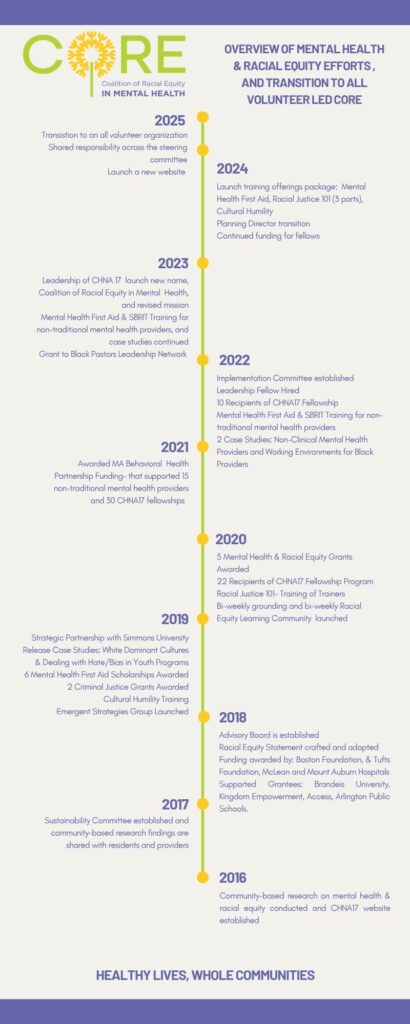
Our journey from quasi-governmental community coalition to racial equity non-profit is outlined in our Timeline at the right. When the Commonwealth eliminated support for the CHNA system, we began investing in strategic planning and listening to our communities to understand how to most effectively leverage our coalition to contribute to local health improvements. This culminated in refocusing clearly and intentionally on racial equity in mental health, rebranding CHNA17 as CORE Mental Health in 2023, and becoming an all-volunteer organization in 2025
CORE Mental Health provides a longstanding and trusted space for community health professionals from neighboring towns and cities to do the hard work of focusing on racial equity and mental health together. We all know this work is necessary to make meaningful impact. It takes time and commitment, and most of us don’t have the resources in our own organizations. I believe that the CORE”s regional model of dedicating entirely to racial equity and mental health is remarkable. This commitment alone has literally invited hundreds of local residents and public health professionals to contribute to this extraordinarily inclusive community of learning. – Stacey King, Harvard T.H. Chan School of Public Health, Former CORE Advisory Committee Member